What Is the Difference Between AI and Machine Learning?
AI is the wider field; machine learning is one way to build AI systems.
AI and machine learning: the short answer
Artificial intelligence, or AI, is the broad field of building systems that perform tasks linked to human thinking. Machine learning, or ML, is one part of that field. It lets a system learn patterns from data and improve at a task without a person writing every rule.
So, what is difference between AI and machine learning? The main difference is scope. AI describes a broad goal and field. ML describes a group of methods used to reach that goal.
Not every AI system learns from data. A rule-based tool can still count as AI. And an ML system can perform a narrow task without thinking like a person.
They overlap, but they are not the same thing.
Consider a route planner. One version may use rules to avoid closed roads. Another may learn travel times from past trips. Both help choose a route, but the second uses ML.
What artificial intelligence means
AI covers computer systems built to carry out tasks that call for skills such as pattern finding, language use, planning, or choice. Some systems use learned models. Others rely on rules, search methods, or a mix of tools.
People often group AI into three types. Artificial Narrow Intelligence (ANI) handles a defined set of tasks. Artificial General Intelligence (AGI) would match human ability across many tasks. Artificial Super Intelligence (ASI) would exceed human ability across a wide range.
ANI is the kind seen in products today. AGI and ASI remain ideas, not proven products. A speech tool can turn spoken words into text, for example. It cannot drive a car or plan a budget without other systems.
AI names the wider field, not one single tool.
AI applications include natural language processing, image recognition, and systems that guide vehicles. Some of these tools use ML. Others combine learned models with rules or search.
The label alone does not tell you what a tool can do. Look at its task, its limits, and the way it reaches an answer.
How machine learning works
ML teaches a system to find patterns in examples. A team gives a model data and a clear goal. The model adjusts its settings during training, then uses what it learned on new cases.
A shop could train a model on past sales, prices, and seasonal trends. The model may learn which items tend to sell more in winter. It can then help forecast demand for the next season.
That forecast is an estimate, not a promise. Staff can weigh it alongside stock levels, supplier plans, and local events. This is one way ML can support data-driven decisions.
Good examples matter.
Deep learning is one type of ML. It uses neural networks with many layers to find complex patterns. These methods can work with speech, pictures, and language, but often need more data and computing power.
Teams should test a model with examples it did not see during training. They should also check how errors affect users. A model that scores well in a test may still fail in daily use.
Machine learning applications include predictive analytics and recommendation systems. A shop may suggest products based on past choices. A repair firm may estimate which machines need service soon.

Key differences between AI and ML
The difference between AI and machine learning is easiest to see through scope and method. AI is the broad field. ML is a family of methods within it.
AI can use rules, search, planning, or learned models. ML relies on examples to learn patterns. A system may combine both approaches to handle a task.
AI can work with structured, semi-structured, and unstructured data. Structured data includes tables with fixed fields. Semi-structured data has some order, such as tagged records. Unstructured data includes text, sound, and images.
ML often uses structured or semi-structured data in business tasks. Modern models can also learn from raw text, audio, and images. The data type depends on the model and its goal.
Here is a quick comparison.
| Question | AI | Machine learning |
|---|---|---|
| What does it describe? | A broad field for smart systems | A way to learn patterns from data |
| Must it learn from examples? | No | Yes, during model training |
| Common methods | Rules, search, planning, or learned models | Models trained on examples |
| Example | A rule-based tool that routes support cases | A model that predicts case type from past cases |
In short, ML sits inside the wider AI field. This distinction helps teams describe tools with care. It also helps them set fair limits on what a system can do.

AI, automation, chatbots, and language models
AI and automation are related, but they mean different things. Automation means a task runs with less human effort. It can use simple rules without AI.
For example, a system can send a set email after a form arrives. That is automation, but it does not need to learn or understand the request. AI can make automation handle less tidy inputs, such as messages written in many ways.
A chatbot is a tool that talks with people through text or speech. It may use AI, fixed scripts, or both. So, the difference between a chatbot and AI is that a chatbot is a type of product, while AI is a wider field.
A large language model, or LLM, is a model trained to work with text. It can draft, summarize, or answer questions. An LLM is one kind of AI system, not a synonym for all AI.
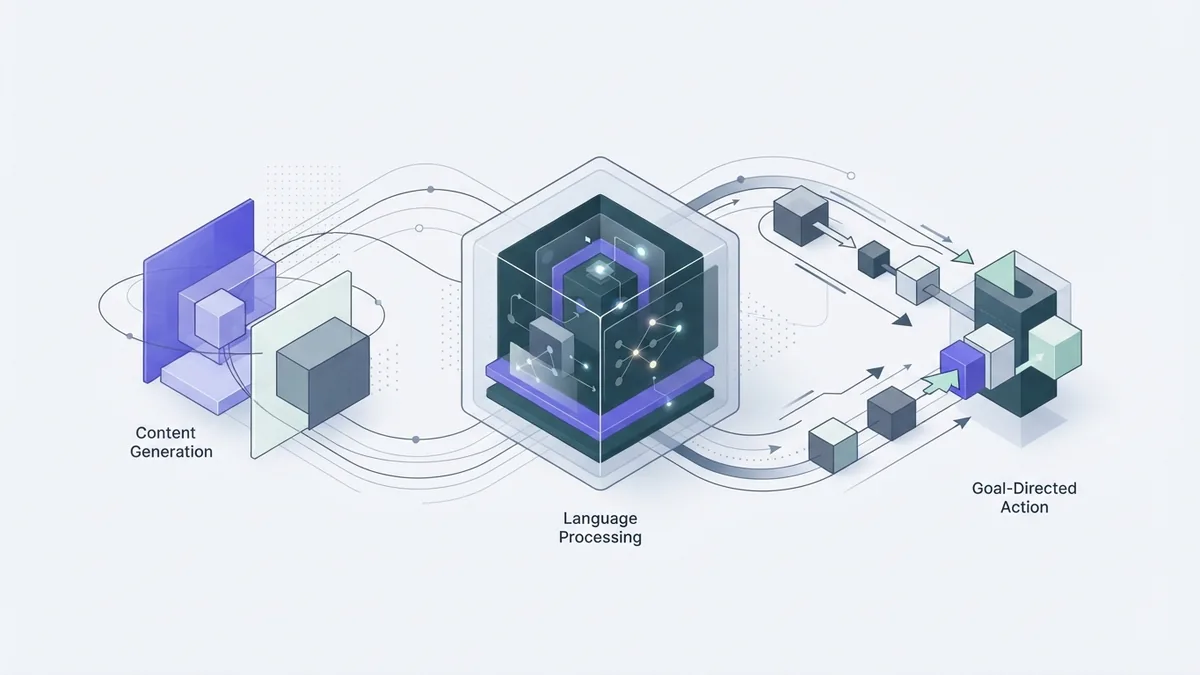
Generative AI, often called GenAI, makes new content such as text or images. Agentic AI refers to systems that can plan steps and use tools toward a goal. These ideas can overlap, but they are not identical.
What is the difference between AI and agentic AI? AI is the broad field. Agentic AI is a narrower kind of system that can take steps toward a goal with some independence.
What is the difference between GenAI and agentic AI? GenAI makes new content. Agentic systems act on goals, and may use GenAI as one part of their work.
Likewise, the difference between an LLM and AI is one of scope. An LLM is a model type within AI. An agentic system may use an LLM, but it also needs ways to plan, act, and check results.
These terms describe different parts of a system.
Applications of AI and machine learning
AI and ML support work across many fields. A language tool can sort support messages by topic. An image system can flag possible faults in product photos. A vehicle system can combine sensor input with rules to guide movement.
ML is useful when past examples can help with a future choice. A sales team may forecast demand. A media service may suggest shows based on viewing habits. A bank may flag payments that differ from a customer's usual pattern.
These systems can help people make decisions faster. They do not remove the need for checks. A forecast can miss a sudden change, while a recommendation can reflect gaps in its data.
Start with the task, not the label.
Before choosing a tool, ask what decision it supports and what data it needs. Set a clear way to measure good results. Then test errors, costs, and the need for human review.
- Use rules when the task is fixed and the inputs are clear.
- Consider ML when examples can reveal useful patterns.
- Use a broader AI system when the task needs several methods.
- Keep a person involved when errors carry a high cost.
This approach helps businesses match tools to real needs. It also avoids buying a system just because its label sounds advanced.
Conclusion: choosing the right terms
AI is the broad field of systems that perform tasks linked to human skills. ML is a way to build some of those systems by learning from data. That is the core answer to “what is the difference between AI and machine learning?”
Other terms name different layers. Automation describes work done with less human effort. Chatbots are tools for conversation. LLMs handle language, GenAI makes content, and agentic systems can take steps toward a goal.
Knowing these links helps teams judge claims and plan useful projects. Focus on the task, the data, and the system's limits. The right tool is the one that fits the job.
Frequently asked questions
- What is the difference between AI and machine learning?
- AI is the broad field of building systems that perform tasks linked to human skills. Machine learning is one part of AI that learns patterns from data.
- What is the difference between AI and automation?
- Automation runs tasks with less human effort and can follow fixed rules. AI can help systems handle tasks that need pattern finding, language use, or choices.
- What is the difference between an LLM and AI?
- An LLM is a model built to work with language. AI is the wider field, which includes LLMs and many other kinds of systems.
- What is the difference between GenAI and agentic AI?
- GenAI creates content, such as text or images. Agentic AI can plan steps and use tools toward a goal, and may use GenAI along the way.
- Is a chatbot the same as AI?
- No. A chatbot is a tool for conversation, and it may use AI, fixed scripts, or both.
- Can AI work without machine learning?
- Yes. AI systems can use rules, search, or planning methods without learning from data.
Related reading
What Is AI Inference? How It Works
See how AI models turn new data into useful answers and predictions.

What Is Cloud Application Development? (Key Steps)
Learn how cloud apps are planned, built, secured, and scaled.

What Is the Best AI Chatbot? Compare Leading Apps
Compare top AI chatbots by task, features, price, and privacy.